The Bennet family were prominent Poyntzpass merchants and mill owners in the 1800s.
George Bennett Snr.
George (1768-1823) was the first Bennet to settle in the village. He married Jane Evans (1762-1824) and they had four children:
- Mary Jane (1798-1859) who married Rev Alexander Bryson (1786-1855)
- John (1799-1866) who married Elizabeth Boyd (1810-1847) who was 20 years his junior
- George S (1800-1895) who married Anna McGarry (1800-??)
- Diana (1807-1877) who married Robert MacMurry (??-??)
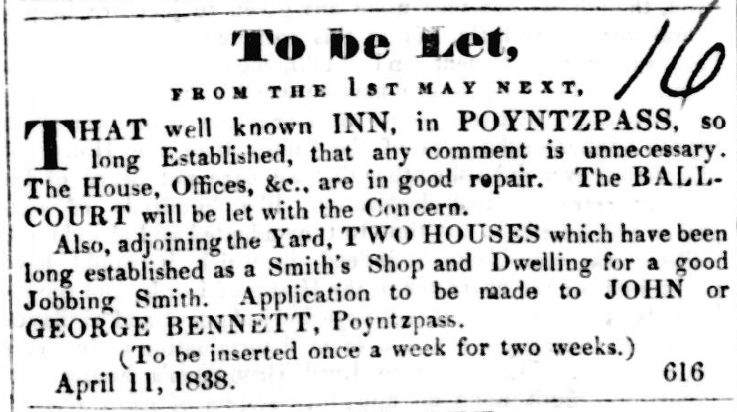
In 1830, the farewell dinner for Dr Nesbitt was held in Bennet’s Inn, owned at the time by George Jnr. He put it up for sale April 1838, at which time it was described as “long established”. We do not know which of the village’s historic pubs/inns this was.
John Bennett Snr.
John and Elizabeth had eight children:
- George, born 1830, who died in infancy
- Jane (1831-1906) who married James Annett (1839-1912)
- William Boyd (1835-1897) who married Marion McCaldin (1866-1933)
- Elizabeth (1836-??)
- Robert (1839-1883) who married Isabel McCaldin (1847-1910), Marion’s sister(??)
- Edward M (1842-1897) who married Helen Clarke (1848-1926)
- James Ward (1845-1932) who married Catherine Kyle (1851-1920)
- John (1850-1923) who married Mary Moore (1851-1922)
William Boyd Bennet
George’s oldest surviving adult son, William Boyd Bennet, lived at the top of Railway Street, opposite the old police barracks. He was a farmer, ran a tannery next to his house (on the site of the saleyard), and owned several water mills on the river just west of the village, off the Tannyokey Road. In Slater’s 1881 Commercial Directory, he is listed as the owner of both a corn mill and a scutch mill. These had been purchased from the Crothers family. He had learned the tanning business from his uncle.
He was also an estate agent, often appeared in he list of prize-winners at agricultural shows, and was a member of the Board of Guardians of the Newry Union.
Along with his brother Robert, William appeared at the Petty Sessions on 9th September 1875, charged with shooting and wounding Daniel Bailie and Patrick Lennon in the recent ‘Poyntzpass Riots’. Both were acquitted at the 1876 Armagh Spring Assizes.
William died in Belfast on 13 Feb 1897. The probate record states that he held the title of Armagh Baronial High Constable.
Mill Farm, Tullynacross, on which were sited a flax mill and a corn mill, were finally sold at auction in January 1907.
Robert Bennet & Rev. John Bennett
William’s brothers Robert and John were linen merchants and manufacturers, and agricultural seed merchants. They shared a house next door to William and when it burned down in 1878, they moved into William’s house. They received £1,362 from their insurance company but were declared bankrupt in February 1879. They were later brought before the bankruptcy court charged with having distributed the proceeds of the fire insurance preferentially and illegally to just three creditors.
Robert and William appeared at the Petty Sessions on 9th September 1875, charged with shooting and wounding Daniel Bailie and Patrick Lennon in the recent Poyntzpass riots; both were eventually acquitted.
John Bennet was also Master of Poyntzpass LOL 189, and was the principal benefactor of the Orange Hall. He donated the land and some money, and laid the foundation stone on 6th May 1871. It opened with great ceremony on 5th July. However, more money was still needed, and so on 6th November 1878, a meeting was held in the Manchester Hall, Tandragee where it was announced that the proceeds of the meeting would be devoted to “the liquidation of a debt on the Poyntzpass Orange Hall”.
Fast forward to 19th January 1899, almost 30 years after the hall opened … John Bennet was no longer a prosperous linen merchant. He was now the Rev. John Bennet (a Church of Ireland cleric), lived far from Poyntzpass and had fallen on hard times. At Ballybot Quarter Sessions, Bennet sued the trustees of the Orange Hall for the recovery of unpaid rent – five shillings a year which (in the years it had been paid) he gave straight back to the Lodge! The trial was rather chaotic and neither party could produce a copy of the lease until the very end of the case.
The judgment was given at the following Quarter Sessions in April, in favour of Bennet, with the judge remarking that he would allow the parties to go to another tribunal if they wished. Rev. Bennet was also awarded £1 travel expenses!
James Ward Bennet
PRONI holds two manuscripts that are collectively known as the Bennet Diaries1, or the Poyntzpass Diaries (PRONI ref D4648).
The actual diary was written by James’s mother, Elizabeth (nee Boyd). The other document, a journal, was written by James who called it:
“[A] History of people who lived and died in Poyntzpass and neighbourhood from early years …up to the year 1880 said year I left it with some remarks about them. Also a few country people’s names who were well known to me. And a few other remarks about places etcetera around Poyntzpass.”
These volumes are currently being transcribed by members of the P&DLHS.
Brushes With The Law
Sisters Elizabeth and Jane were found guilty of malicious assault (upon whom is not recorded) at Tandragee Magistrates Court in 1841.
Eminent C20 Bennets
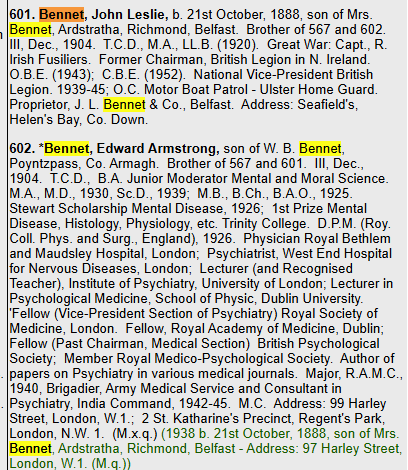
Two of the Bennet family were eminent in the 20th century.
The Rev. Dr. Edward Armstrong Bennet (1888-1977) was an eminent psychiatrist with premises at 42 and 97 Harley Street. He served in the army in the First World War, leaving in 1920 with the rank of Brigadier. Among his publications was the book The Psychopathology of Sexual Perversions.
His twin brother Capt. John Leslie Bennet (1888-1963) also served in the First World War, and was severely wounded at Gallipoli. After the war, he was appointed head of the British Legion in N Ireland at its inception in 1921 and served in the role until 1952; he often represented the Legion at overseas events. The Legion’s former respite hotel in Portrush, Bennet House, was named after him, and a memorial plaque was unveiled on Bennet House, Helen’s Bay, in 1964.
- See “The Bennet Diaries” by Michael Anderson, BIF Vol 17, 2022 ↩︎