The D&BJR. 1844-55
Rev. Norman Gamble A SCHEME IS BORN
The title of the Dublin & Belfast Junction Railway seems to fascinate many people who point out that in actual fact, the Company’s line never joined the two towns mentioned. Yet, the title is truly descriptive of the Company’s purpose. It was a JUNCTION railway, a gap filler whose construction made possible a through rail route between Belfast and Dublin. In its day, it was commonly referred to as the “Junction” Railway, just as its close relative, the Dublin & Drogheda, was commonly called the “Drogheda” company, and I will use both these titles throughout these papers.
This paper tells the story of how the Junction line was built and operated in its early days, until the construction of the great viaduct across the River Boyne at Drogheda in 1855. The completion of the line took no less than eleven years, but in fact the story of the Junction goes back for almost two decades before that. It is a curious point that its history seems to have progressed in ten-yearly steps. It was first projected in 1825, surveyed in 1835, sanctioned in 1845, completed in 1855 and became extinct through merger in 1875. The year 1865 does not seem to have been a notable one, but there is said to be an exception to every rule! The year 1825, more notable for the opening of the Stockton & Darlington Railway, also saw the promotion of the Leinster & Ulster Rail Road. As with many other contemporary schemes, this proved to be too ambitious for the technical and financial resources of the time, and came to nothing. But a seed had been sown, and during the next decade railways made rapid advances. The Liverpool & Manchester, with its complete reliance on steam power, opened in 1830, and the Dublin & Kingstown in 1834. Its success led to a veritable outbreak of schemes in 1835, including the Drogheda line, which was incorporated in 1836 after a tremendous parliamentary battle, and opened to traffic in 1844.
I have described the early days of the Drogheda in previous papers in the JOURNAL (64-5,84-7), and it is not my intention to repeat what is written there. However, it should be pointed out that the D&DR had great ambitions for a northward extension from the beginning. These ambitions were enshrined in its earliest title of Grand Northern Trunk Railroad until its ambitions had been clipped by the House of Lords, and as early as 1835, the Provisional Committee of the D&DR had commissioned John Macneill to survey a route northwards to join the Ulster Railway.
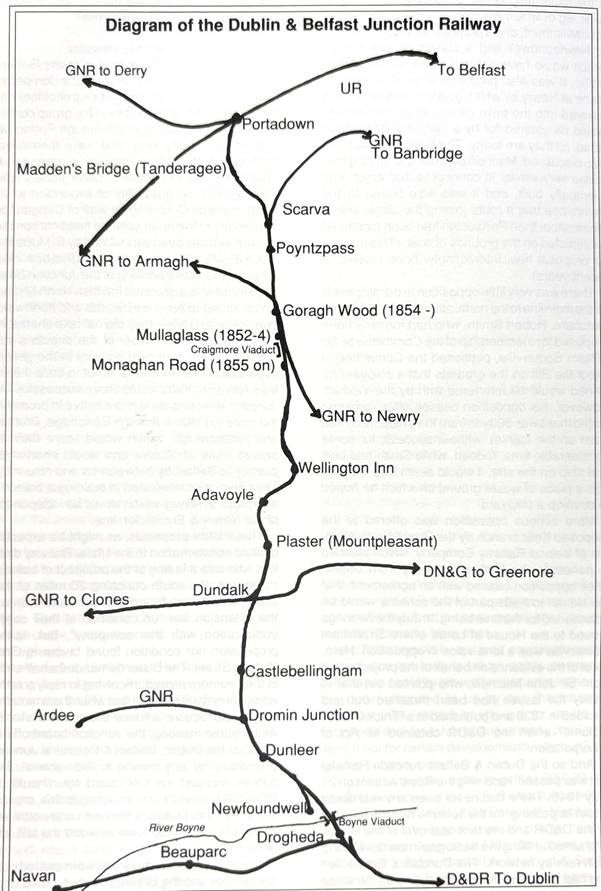
Macneill’s survey provided the basis for the Junction route as far as Dundalk, but then ran along the north shore of Dundalk Bay and thence by Carlingford to Newry in order to avoid steep gradients. The survey was put to one side in the following years as the Drogheda Company struggled to build its own line, but as it neared completion, its old ambitions surfaced once more. The long-term justification for the D&DR lay in its being the southern portion of the Dublin and Belfast route. It was also, however, becoming evident that the Ulster Railway would be of little assistance. Its directors were quite willing to accept traffic from the south, but were themselves concerned with extending their line into the heartland of southern Ulster, where they reached Armagh in 1848 and subsequently busied themselves in the promotion of schemes running south towards Cavan and north and west from Portadown towards Dungannon and Omagh.
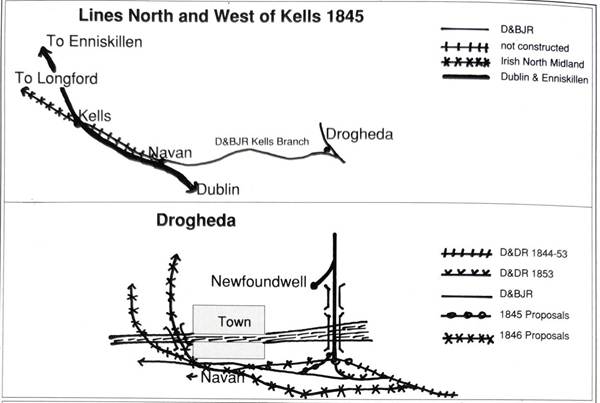
It is easy for us today to forget that there was another direction in which the D&DR might have channelled its energies. Just as the Ulster directors saw their future in the opening up of trade through Belfast along the Lagan Valley, so too the people of Drogheda looked up the Boyne Valley into the heart of the Irish Midlands. Along that valley there were three centres of importance, Slane, Navan and Kells. From Kells lay a number of feasible routes to the west and north-west along which already flowed a considerable traffic in travellers, livestock and provisions, much of it moving through the thriving port of Drogheda.
By 1844, the D&DR directors decided that they would promote a line to Kells and encourage local schemes radiating from there. But they were not prepared to put their funds at risk. Instead, they prudently restricted themselves to the supply of backing and support for others, and called a meeting of interested parties which was held in their offices at 22 Marlborough Street on 6 April 1844 “for the purpose of taking the preliminary steps necessary for the formation of a Company to make a railway between Drogheda and Portadown and between Drogheda and Kells.”
Those present decided to press on with the scheme. Most of them were Dublin businessmen who were associated with the D&DR, and among the attendance were Peter Eckersley, the Drogheda’s Secretary, and John Macneill, their Engineer. A prospectus was drawn up and Macneill predictably appointed as Engineer and Eckersley as Secretary. And so the Dublin & Belfast Junction Railway (not forgetting the all-important branch to Kells!) began its life.
Those present established a Provisional Committee which included eight peers among its members. Only one of them, the Earl of Charlemont, actually took any part in the Company’s affairs, but the remainder were useful in creating an air of solidity which might impress potential investors. The D&DR sponsored a survey of the line, which estimated the cost of construction at about £10,000 per mile, and the prospectus which the Committee issued held out the hope of a journey time between Dublin and Belfast of about 3 1/2 hrs, and from Dublin to Glasgow of 10 1/2 hrs. Great hopes were proffered concerning the prosperity of the scheme, and it was claimed that the Kells branch alone would yield a profit of 11%, and that its freight traffic alone would be sufficient to pay the operating expenses.
Over the ensuing weeks, other influential names were added to the Committee, although not all overtures to join met with success. Lord Headford, whose estate lay across all the routes west of Kells, refused to allow the line onto his lands and this boded ill for any westward extension into the Midlands, while the Archbishop of Armagh expressed interest in the scheme but refused to do anything more substantial. It would seem that His Grace remembered the controversy over the D&DR Bill of 1836, and in his heart still harboured hopes that a direct link between Dublin and Armagh might be constructed. Subscription lists were opened on both sides of the Irish Sea, and the Provisional Committee were heartened by the interest shown by the London & Birmingham Railway in the project. However, when the LCBR were asked to make a commitment by subscribing for shares, they diverted the letter to the Chester & Holyhead Railway who were finding it hard enough to build their own line and had no money to spare for any Irish adventures!
However, by and large, the shares found a ready market. The project seemed reasonably sound and the slump of the Famine years had not begun. The scale of investment varied enormously, ranging from £100 by one Michael Kennedy, an illiterate farmer from Coolock, to two Manchester merchants, Charles Twemlow and John Turner, who each invested £11,000.
An analysis of the investments (Table 1) reveals some interesting statistics. One is the lack of interest shown by the businessmen of Belfast and the surrounding area, in a line which could only serve to greatly boost traffic on the Ulster Railway. The other is the relatively large holdings of the various English investors, and especially those from Manchester, which gave them, as on the D&DR, an influence greatly out of proportion to their numbers. Businessmen from this area, which was the heartland of the modern railway system, were always ready to invest in schemes outside their immediate area, and many of them had business connections with the east coast towns.
Another feature of the shareholding pattern is the almost total lack of interest by the landowners in the Boyne Valley. Some of them had supported the Dublin & Armagh (Inland) scheme in 1835-36 and still considered that the natural way in which they should be provided with railway facilities was by a line leading directly from Dublin to Armagh. Their general hostility to the D&DR would seem to have been a major force behind the many difficulties which the Junction directors experienced in both the purchase and surrender of land during the construction of the Navan branch. Likewise, the Drogheda merchants could see little in the scheme which would benefit the town, as it was evident that, without access to the quays at Drogheda, the trade of the Boyne Valley towns would be diverted to Dublin or to Belfast.
The businessmen and gentry of Dundalk and Newry were promoting schemes for railways into the hinterland of their respective ports and also showed little inclination to invest in the Junction. The Dundalk scheme was that of the Dundalk & Enniskillen, which was in many ways complementary to the Junction project, and which was always its staunch ally in the railway politics of the age. The Newry project was that of the Newry & Enniskillen, whose early history of financial ineptitude was a major influence on the affairs of the Junction, and rarely for its good.
Just to complicate matters, the Junction itself was not without its ambitions, in which it became embroiled even before it had completed its list of subscribers. The years 1845-46 were a period of great enthusiasm for railway projects, when schemes were brought before the public providing railways for the most unlikely places and offering the most exalted hopes. As soon as 3 May 1844, the Junction’s Provisional Committee began to investigate a possible extension from Kells to Longford. They estimated that this line could be built for £334,000 and yield a profit of 7½%. They were only saved from pursuing the matter further by the wise counsels of their Solicitor, Crozier, who gently pointed out to them that their subscribers had only signed up to build a line as far as Kells. This warning did not lead to an abandonment of the project, but only to a realisation that it would be up to others to promote the western extensions.
Any scheme for a line between Dublin and Belfast had to take into account the Ulster Railway, which the Committee realised could be difficult to deal with. In order to prepare themselves, they sought advice from both Manchester and the D&DR on how other companies managed their relationships with connecting lines, and then sent a deputation to Belfast. The Ulster board were in no hurry to talk, and it took almost a month before a conference could be arranged on 10 October 1845. When it was held, it was amicable enough, although the Ulster directors refused to make any. promises of any kind. The Junction representatives, however, left with an understanding that their Bill would not be opposed by the UR, and prepared their final plans, depositing them before Parliament in November.
All seemed to be going well. Many of the landowners along the main line between Drogheda and Portadown intimated that they would be prepared to give land to the Company at a very reasonable valuation, and would themselves undertake negotiations with their tenants, thus
saving the railway company much time-consuming and potentially expensive negotiation. The Boyne Harbour Commissioners, also, whose cooperation for the crossing of the Boyne was vital to the Company’s success, came to terms with the Committee for a viaduct with 90ft clearance for shipping provided that 400ft of wharfage would be built on the east side of the viaduct, after a vain attempt to have the line to terminate on the north side of the Boyne. The terms were onerous, and were extracted under some coercion, but at least they were agreed.
By the end of 1844 three Bills were in process of being submitted to Parliament, those of the Junction, the DCER and the NCER. The Dundalk & Enniskillen’s promoters were suspicious of the NCER, and quite rightly felt that only one of the two lines would succeed in reaching Enniskillen. They persuaded the DCBJR Committee to oppose the NCER, on the grounds that it would abstract traffic from the Goraghwood to Portadown section of their line and so weaken its financial viability.
However, the Junction’s engineer, Sir John Macneill, was a close friend of the NCER’s engineer, Sir John Rennie. One evening in February, the two men walked home together after a meeting of the Royal Society in London. Rennie confided in Macneill his worries about the NCER Bill being successful in Parliament against the combined opposition of the Junction and the DCER. Macneill went into Rennie’s house for a drink and over it they agreed that the Newry line should be allowed to go to Clones without opposition from the Junction, and that the two engineers would together select the best route from there to Enniskillen, which would be constructed jointly by the DCER and NCER.
The two engineers had acted without any authority or blessing from the directors of the companies concerned, but such was Macneill’s standing in the Irish railway world that the Junction and DCER directors were unable to discipline him. After initial apoplexy the Junction board dropped their opposition to the NCER. It was about the last occasion on which they would fail to oppose the line and just about the only occasion on which they ever let the DCER down! As it turned out, the NCER never managed to get within reach of Clones and the informal agreement was never put to the test.
A more serious problem which the Junction committee faced arose in Drogheda as the Bill came up for hearing in Parliament. Some of the town’s businessmen came to the conclusion that the Committee were ignoring the hopes for a westward expansion and that the project had fallen into the hands of Dubliners and Englishmen whose sole ambition was the line to Belfast. Sir William Somerville, MP for Drogheda, in a letter to the Committee, asked that two Drogheda businessmen, Robert Smith and William Cairnes, should be added to the Committee, in order to ensure that the Company fulfil its obligations in respect to the Kells line and to safeguard the interests of the Drogheda business community. Somerville received a sharp rebuff, the Committee’s reply stating firmly that: “the Board would by such an act acknowledge that we are not men in whom public or private confidence could be placed for the performance of the duties reposed in us by the Proprietary”. However, the matter continued to rankle in Drogheda and could have caused many problems were it not for certain developments which will be related
subsequently.
The Parliamentary battle to get the DCBJR Bill enacted had none of the high drama surrounding the D&DR Bill of 1836 (JOURNAL 64). Macneill’s agreement with Rennie was of course raised when hearings began in May, but there was nothing that anyone wanted to do about it. Some interesting points come out of an examination of the evidence given. Among these were plans for a triangular junction at Drogheda, the north-to-west leg of which would have destroyed the
historic Millmount, and a proposal for a goods station at Newfoundwell and a station on the triangle which would have catered solely for passenger traffic. It was also proposed to build an inclined plane at Newry by which goods would have been lowered into the town centre, while passengers would be catered for by a station at Monaghan Road, as they are today. The Boyne Viaduct was also discussed, Macneill proposing a lattice girder bridge very similar in concept to that which was eventually built, and it was also stated to the Committee that a route joining the Ulster line at Moira rather than Portadown had been examined but rejected on the grounds of cost. (This particular proposal has, interestingly, been revived in recent years).
There was very little opposition to the proposals for the main line to the north, although the Drogheda merchant, Robert Smith, who had formerly been proposed for membership of the Committee by Sir William Somerville, petitioned the Committee to reject the Bill on the grounds that a shipyard he owned would be interfered with by the Viaduct. However, his opposition ceased after someone stated that it was 500yds from the Viaduct and had been on the market, without success, for some considerable time. Indeed, while Smith had built one ship on the site, it would seem that the land was a piece of waste ground on which he hoped to develop a shipyard!
More serious opposition was offered to the proposed Kells branch by the Grand North Western of Ireland Railway Company, which planned to penetrate the Midlands directly from Dublin. Their opposition ceased with an agreement that the Navan to Kells part of the scheme would be abandoned for the time being. In July the hearings moved to the House of Lords where Sir William Somerville was a lone voice in opposition. Here, most of the evidence on behalf of the project came from Sir John Macneill, who pointed out that in reality the issues had been thrashed out and decided in 1836 and published in a “Thick Octavo Volume” when the D&DR obtained its Act of Incorporation.
And so the Dublin & Belfast Junction Railway Act was passed, receiving the Royal Assent on 21 July 1845. There had never been any real doubt about its passing, for the scheme had the backing of the D&DR and the tacit approval of the Ulster, and aimed at filling in a basic gap in the developing Irish railway network. The Dundalk & Enniskillen line had also been incorporated, and so the stage was set for the extension of the Irish railway system into what we now think of as the border counties of Monaghan and Cavan.
PLANS FOR EXTENSION
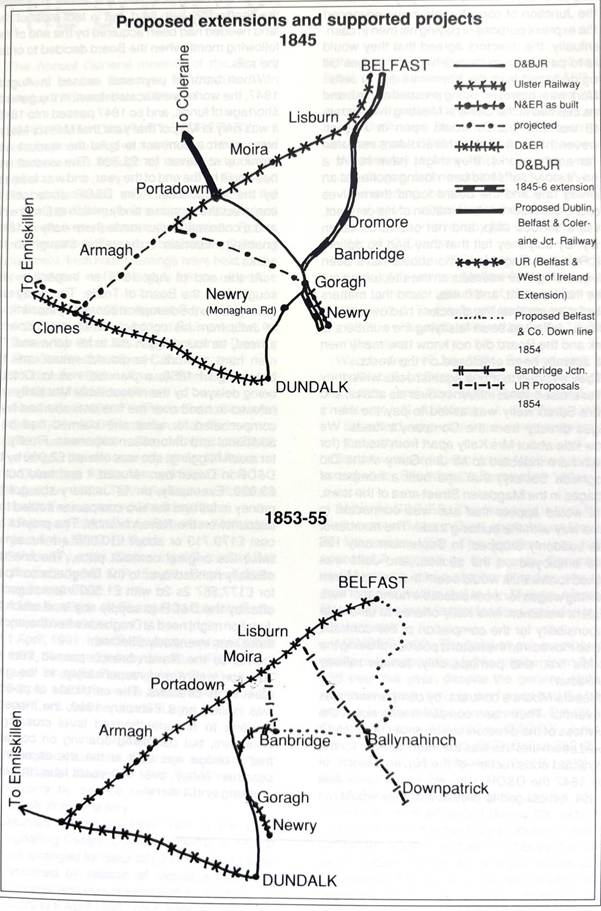
There was an air of optimism at the General Meeting on 21 July 1845 following the Company’s incorporation. The assembled shareholders harboured thoughts of expansion. One group considered that the proposed route through Portadown was unnecessarily long, and were themselves floating the idea of an alternative approach to Lisburn by way of Dromore. Other parties were interested in the possibility of expansion to the 08 north, towards Coleraine by way of Dungannon. The history of this latter scheme need not concern us here as it has been well related by B. McDonald in JOURNAL 100, except to record that both ideas received the active backing of the Junction Board The Board also supported the Irish North Midland which aimed to push westwards and northwards from Kells, and while they did not take shares in it as a Company, a number of the directors subscribed to it on their own account in the general expectation that another attempt to build the line from Navan to Kells would prove successful. The Junction directors were more active in promoting the route to Lisburn through Banbridge, Dromore and Hillsborough, which would leave their approved route at Scarva and would shorten the journey to Belfast by between six and nine miles. They were also interested in
building a branch to the quays at Newry which would be independent of the Newry & Enniskillen line.
These latter proposals, as might be expected, caused consternation to the Ulster Railway directors who saw a fading of the prospect of lucrative traffic from the south enriching 25 miles of their line. The Junction board offered them shares in the extension line “on condition of their cordial cooperation with this company”, but neither proposition nor condition found favour in Great Victoria Street. The Ulster demanded a half-share in the Dromore project, receiving in reply a rather non-committal statement that when the time came, they would receive “a liberal allocation” of shares. At the same meeting, the Junction board offered to assist the Dublin, Belfast & Coleraine Junction promoters ‘by any means in their power’. This further enraged the UR board for, should the DBCCJR succeed in constructing its line, much of the traffic from Dublin to the north and north-east of the country would have avoided the UR altogether.
Surveys of the Dromore line were carried out in September and the UR was offered a third of the shares in the project, the cost of which was estimated at £475,000. An offer was also made to the Junction shareholders, of shares in the Dromore extension at a rate of one share for every two Junction shares held.
Then the UR discovered that there was another suitor for the Dromore line in the shape of the Grand County Down Railway whose proposed line swept from Belfast through East Down to Newry and on to Warrenpoint. Its promoters agreed to invest £225,000 in the Dromore route, in return for representation on the DCBJR Board. It was agreed that the two companies would share running powers, which would allow the Junction access to Belfast without having to make any recourse to the UR.
In actual fact, all three schemes died when the “Railway Bubble” burst in the autumn of 1845. The Grand County Down faded away; the only scheme which could be said to result from it was the lowly Newry, Warrenpoint & Rostrevor. The Dublin, Belfast & Coleraine Junction expired to all intents in September 1846 when it was not able to summon up a quorum at its General Meeting, although its ghost hung around the Irish railway scene for a few years. The Dromore extension was wound up, having failed to attract any real attention save that of Mr Bateson, owner of Belvoir Park, who steadfastly refused to allow the line through his estate which lay astride the only alternative access to Belfast through the Lagan Valley to that of the UR. The Irish North Midland Bill was rejected by the House of Lords in 1846 and the rival Dublin & Enniskillen Bill was almost simultaneously rejected by the House of Commons, although the Junction still retained a lively interest in any schemes for westward extension.
The economic depression of the late 1840s resulted in an acute shortage of spare capital, and investors who had had their fingers scalded when the bubble burst were increasingly wary of railway speculations. In Ireland the situation was made worse by the crop failure of the “Great Famine”, and even a Company which had achieved its Act of Incorporation had to struggle for survival.
The Dublin & Enniskillen line had been opposed by a coalition of the D&DR, Junction and Dundalk & Enniskillen companies. This “triple alliance” was to prove a stable and lasting one, and began in 1845 when the threesome opposed the NCER, which had been incorporated thanks largely to Macneill’s deal with Rennie, but a year later Macneill, who was engineer to all three lines, was utterly exasperated with the Newry concern. Pressure was put on the NCER to abandon all but the line from Goraghwood to Newry. This would have turned it into a vassal of the Junction and routed Richill and Armagh traffic over the entire length of the Junction line. The DCER opposed the NCER because it feared that if the latter ever reached Armagh, it might then try to fulfil the ambitions expressed in its title! However, an attempt to limit the NCER by clauses in an amending act failed, and the NCER remained unscathed, if perpetually in a state of financial impotence.
The triple alliance emerged again in 1853 when there was a revival of schemes for the Armagh area and united opposition was offered to the UR’s protege, the Belfast & West of Ireland Junction (Armagh to Clones) line. At the same time the allies made it clear that they were ready to invest in any scheme striking west from Portadown towards Dungannon and Omagh.
A year later, the allies joined forces again. The MCGWR was coming up to Cavan from the south and the Ulster approaching from the north. The DCER felt that it was being restricted by a pincer movement, and a conference was held in Dublin on 11 September 1854 at which the Midland was persuaded not to go beyond Cavan, while the Ulster agreed that the DCER could build the Cavan to Clones line and thus leave a window open for westwards expansion.
Meanwhile the Junction were flirting with the Belfast & County Down, proposing a line from Scarva to Banbridge and Ballynahinch and thence to Belfast. The Ulster protested and were bluntly told that the Junction were doing this because of “the hostile attitude to the interests of this Company which the Ulster Company have lately assumed in many ways”, probably a reference to grievances about connections and facilities at Portadown. The Ulster in retaliation proposed lines from Banbridge to Moira, and from Lisburn to Downpatrick, which naturally met with stern opposition from the Junction and the BCCDR. After a number of meetings, the Ulster agreed to give up its plans for Banbridge and not to oppose the DCER’s ambitions in the Clones area, if the Junction would terminate its liaison with the BCCDR. A final agreement was reached at the end of October in which the Ulster consented to leave future extensions in County Down to the BCCDR. The Junction agreed to do the same and thus surrendered its plans for extension. From now on, it would instead seek amalgamation with the other companies sharing the Dublin – Belfast route, a move which had been authorised by Parliament as early as 1847.
PREPARING FOR CONSTRUCTION
However, we have allowed ourselves to run far ahead in time and it is necessary to return to the year 1845 and chronicle how the Junction actually built its line. It was no easy task: even the D&DR, which had opened its line, faced great difficulties in keeping its head above water in the financial troubles of 1845-47.
Nevertheless, the directors set to work with a will as soon as the Act had been passed. Within six weeks they had reached agreement with Sir John Macneill for his services as Engineer- in- Chief for £22,200. He was to be paid £500 a month, a sum which indicated that it was intended to have the line completed by the end of 1848 or early 1849, and on 17 September 1845 tenders were sought for the building of the line to Navan. Messrs Jeffs, who had built the Royal Canal to Raheny section of the D&DR, were awarded a contract for the first eight miles from Drogheda for
£36,346, and a contract for the remainder (apart from the station areas at Navan and Drogheda), went to Messrs Moore. The most expensive tender in each case was that of Dargan and McCormick: soon the directors were to bitterly regret not having given them the contract.
Tenders for the “main line” were examined on 25 November. For the Boyne Viaduct, Messrs Mallet of Dublin quoted £28,600 for an iron bridge, and other estimates for the bridge ranged from £69,783 from W. Sykes to £105.786 from Messrs Jeffs. Frightened by the sums involved and suspicious of Mallet’s quotation, the directors decided to leave the viaduct until later, and then whittled the six tenders they had received for the line to Dundalk down to two. Three days later they awarded the Newfoundwell to Dunleer section to Messrs Hammond, Murray & Patterson for £55,300, and the section thence to Dundalk to Killen & Moore for £53,000. Killen & Moore had actually undercut Hammonds in both cases, but the Board feared that to award the two contracts to the same firm could lead to delays, despite the experience of the D&DR with William Dargan. It was another of those decisions they would soon come to regret.
A few weeks later, Dargan & McCormick were awarded a contract to build the line from Mullaglass, near Newry, to Portadown at a cost of £80,000, and it was hoped that this section could be built quickly and put into revenue-earning service. The final award of contracts was made in February 1846 when Moore Brothers contracted to build the Dundalk to Meigh section for £82,000 after some tough negotiations, but no decision was made about the section from Meigh to Mullaglass, only one tender being received, that of Hammond, Murray & Patterson. The section was readvertised in March 1847 when Moore Bros and Killen & Moore both quoted £105,000. The Board agonised over what was going to be a difficult decision, and eventually decided (probably because Craigmore Viaduct was in the section) that as Killen & Moore had a better reputation for their stonemasonry, they should be awarded the contract.
And so by the spring of 1846 all of the line with the exception of one section and the terminus at Navan, had been set out to contract. If all the contractors set to work with vigour, the directors were going to have a cashflow problem, for the money to pay the bills was simply not available. Much of the money speculated in the craze of 1845 had involved non-existent capital, but the shareholders had to find real money to pay the contractors’ bills when they fell in, and the Irish economy was in a state of virtual collapse.
The D&DR directors became worried before even a sod had been turned. They, and the people of Drogheda, could see that the DCBJR was split into two parts, the main line and the branch to Navan, and that if anything was sacrificed to financial expediency, it would be the Navan line. The Junction Board were still interested in northern extensions, and asked the D&DR if the latter would be interested in renting the branch when it opened, in order to assist with the financing of the northern extension through Banbridge and Dromore.
This request was made at the end of January 1846. Within ten days negotiations were under way. The D&DR refused to rent the line, but initially promised to lease it if the Junction extended it to Kells, the rent to be lower if the Dublin & Enniskillen ever succeeded in building its line. The talks stalemated until May when Drogheda Corporation demanded a pledge that work would begin promptly on the Navan line before they would cooperate in providing a site for a station at Newfoundwell. This was a serious matter as the temporary station there would be at the side of the line, where the company had no rights of compulsory purchase.
The Board decided that a leasing of the Navan branch could save them about £5,000, and that Drogheda Corporation would also be reassured, thus providing support against the Dublin C
Enniskillen, whose bill at the time seemed to have every chance of enactment. So negotiations for a takeover of some kind of the Navan branch by the D&DR were pressed on. On 21 August, a committee of both Boards agreed that the matter was indeed an urgent one, and William Evans, a Manchester-based member of the D&DR Board, proposed that the Drogheda should take over the branch entirely. The D&DR would pay the cost of construction, and the Junction would purchase land sufficient for a double line, and lay a single line as far as Navan. This proposal met with general acceptance and it was agreed to have the necessary legislation passed through Parliament as soon as possible.
However, the D&DR did not have sufficient funds to purchase the branch outright and would mortgage it from the Junction, with final purchase to be completed at a later date. The D&DR would not gain any benefit from the line until it was open and many members of its Board felt that any financial support in the meanwhile could end their dividend payments. As a result, it was agreed that interest would be added to the capital cost until the eventual purchase. In exchange, the Junction representatives promised that the Drogheda would have a veto in all matters relating to the branch during its construction.
The arrangement was legalised by Bills brought before Parliament by both companies, which also contained provision for the future amalgamation of all the companies engaged in the Dublin to Belfast line as well as the DCER. They became Acts in 1847 and provided that the D&DR were to pay 4% interest to the DCBJR. If they failed to buy the line on completion, and instead continued the mortgage arrangements, the rate was to be raised to 5% for the first four years and 51/2% for each subsequent year. The average rate for loans at the time was 4% and these clauses thus provided an incentive for the D&DR to complete the deal at the first opportunity.
BUILDING TO NAVAN
While this legislation was passing through Parliament, work had begun on the Navan branch, urged on by Sir John Macneill who saw the project as a great relief work with the potential of employing all available Tabour in Co. Meath. Messrs Moore had their contract since October 1845, but a year later not even a sod had been turned, and they were quite naturally getting rather impatient, pointing out that they had expected to be finished by then. After some tough bargaining, they agreed to retain the contract for an additional payment of £2,000. Similar terms were exacted by Jeffs, and work eventually got under way at the end of 1846.
By February 1847, over 2,000 men were employed. Most of them were being paid for through the nineteenth-century equivalent of a social employment scheme, financed by a presentment on the ratepayers of the barony of Lower Duleek, and subsidised by the Board of Works. The terms of the deal led to some sharp criticism from shareholders when it was discovered that the money must be spent by 31 August 1847 and could only be used for the payment of unskilled labour.
Initially, the Company had many delays in getting possession of the land from a number of hostile landowners. Eventually, a jury was held in Navan in April 1847 to adjudicate on the various claims, generally intermediate between the Company’s offer and the landowner’s demand; for example, a Mr Russell who had claimed £2,000 and had been offered £250, was awarded £458. Some awards were to the Company’s advantage, such as that to Mr Taaffe of Ardmulchan who rejected an offer of £1850 and was awarded £1785.16s 4d. It was claimed in the Irish Railway Gazette that two solicitors, Bolger and Nicholls, had been stirring up resistance
along the line, and this may well have been true, and one suspects from the unwillingness of the local landowners to invest in the project, that those lawmen found ears ready to listen to them. Gustavus Lambert of Beauparc, for example, who had been a leading light in support of the Inland Project in the great debate of 1836, on a number of occasions used his position as a magistrate to favour obstructive tenants. In one case he awarded the occupants of a mud hovel worth £5, £8 compensation against their landlord, namely himself! He was then able to claim this back from the Junction.
Such behaviour may have been the tip on an iceberg. Sir William Somerville who, as we have seen, was no friend of the Company, came to agreements with the Junction and then reneged on them at the last moment, insisting instead on arbitration, and persuaded other landowners to follow his example, thus causing further expense and delay.
No sooner did the Company succeed in making land available to the contractors that other problems arose. When the directors visited Messrs Jeffs on their contract in July 1847, they were greeted with twenty-one blasts of gunpowder. Things were not so jolly behind the scenes, for Jeffs was an advocate of the “truck” system whereby his workers were paid with tokens which could only be spent in certain premises, often owned by the contractor and charging extravagant prices. The D&DR were implacably opposed to the practice and asked the Junction board to put an end to it. Jeffs agreed to do so, but within a fortnight the system was found to be back in use and Jeffs was told that he would only be paid in future if he paid his workmen directly in cash. He was continually in arrears with his pay, and by the end of 1847 his debts in this matter alone were in the region of £1,000, despite the payment to him by the Junction of considerable sums advanced for the express purpose of paying his men in cash. Eventually, the directors agreed that they would have to pay the men themselves, the wages bill being deducted from the payments due to Jeffs.
Work was, however, being pressed ahead, and it was claimed at the General Meeting in February 1848 that the branch would open in August. However, had any of the shareholders ventured as far as the works, they might have heard a different story! Jeffs had been losing money at an alarming rate and the Board found themselves forced to consider the termination of his contract. It was a serious step, and not one to be taken lightly. By July they felt that they had no option. The Resident Engineer, who should have been safeguarding their interests on the site, turned out to be incompetent, and it was found that matters were far worse than the directors had been led to believe. Jeffs had been falsifying the numbers at work and the Board did not know how many men had actually been employed on the works.
They decided to move against Jeffs while they still exercised some influence over his affairs, and a Mrs Sarah Kelly was asked to pay the men’s wages directly from the Company’s funds. We know little about Mrs Kelly apart from the fact (for which I am indebted to Mr Jim Garry of the Old Drogheda Society) that she built a number of cottages in the Magdalen Street area of the town, so it would appear that she was connected in some way with the building trade. The number of men suddenly dropped: in September only 196 were employed on the section, and Jeffs was sacked forthwith: it would seem that he had been claiming wages for a considerable number of non-existent workmen. Mrs Kelly offered to take over responsibility for the completion of the contract, and so moved into the historic position of being the world’s first, and perhaps only, female railway contractor!
| Belfast s Dublin Junction Railway (with Kells Branch) Share Subscriptions 1845 | |||||||
| Amount Subscribed | |||||||
| Residence | £ 50-9500 | £ 1000-1950 | £ 2000-2950 | £ 3000-3950 | £ 4000-4950 | £ 5000+ | Total |
| Dublin | 231 | 125 | 47 | 3 | 4 | 410 | |
| North Co Dublin | 4 | 5 | 1 | 10 | |||
| Drogheda | 11 | 6 | 3 | 20 | |||
| Dundalk | 1 | 1 | 1 | 3 | |||
| Newry | 7 | 1 | 8 | ||||
| Tanderagee | 1 | 1 | |||||
| Belfast | 4 | 2 | 2 | 8 | |||
| Irish Midlands | 7 | 3 | 1 | 11 | |||
| Co. Down | 1 | 2 | 3 | ||||
| Mid-Ulster | 3 | 2 | 1 | 6 | |||
| Other Irish | 2 | 7 | 7 | 2 | 1 | 19 | |
| Liverpool | 13 | 28 | 10 | 6 | 2 | 3 | 62 |
| Manchester | 1 | 15 | 9 | 2 | 14 | 4 | 45 |
| Leeds | 8 | 9 | 5 | 22 | |||
| London | 10 | 27 | 14 | 1 | 1 | 53 | |
| Other GB | 1 | 1 | |||||
| Canada | 1 | 1 | |||||
| Total | 305 | 233 | 100 | 13 | 19 | 14 | 684 |
Messrs Moore’s contract, by comparison, was uneventful. Their main complaint was about the slowness of the directors to surrender land, and it would seem that this was the major reason for the protracted construction of the Navan branch. In July 1847 the D&DR, who would ultimately foot the bill, felt obliged to protest that they would not pay for any delays caused by a failure to provide the contractors with land, but in fact most of the land needed had been acquired by the end of the following month when the Board decided to order the rails.
When baronial payments ceased in August 1847, the works were scaled down, in the general shortage of funds, and so 1847 passed into 1848: it was only in May of that year that Messrs Moore were given a contract to build the viaduct and terminus at Navan for £3,326. The viaduct had been built by the end of the year, and was followed by the station itself. The D&DR undertook to construct the terminus and junction at Drogheda, and a connection was made there early in 1849, enabling materials to be railed through to the works.
At the end of July 1849 an inspection was sought from the Board of Trade. The delay was mainly due to the disruption caused by the removal of Jeffs from his contract. When the inspector arrived, he found much still to be done and 756 men hard at work. He did not return until the beginning of 1850, a planned visit in October being delayed by the redoubtable Mrs Kelly who refused to hand over the line until she had been compensated for what she claimed had been additional and unforeseen expenses. Finally, after much haggling, she was offered £2,000 by the D&DR in December, refused it and held out for £3,000. Eventually, on 14 January she got her money in full and the two companies settled their accounts on the Navan branch. The project had cost £179,713 or about £10,000 a mile, almost twice the original contract price. The line was officially handed over to the Drogheda company for £177,587 2s 2d with £1,500 interest and an offer by the D&DR to supply any land which the Junction might need at Drogheda when the junction there was eventually effected.
And so the Navan branch passed from the Junction’s care and responsibility, to the great relief of its directors. The certificate of opening was issued on 8 February 1850, the inspector pointing to an unauthorised level crossing at Beauparc, but permitting opening on condition that a bridge was built at the site as soon as possible. Today, over 140 years later, the level crossing is still there!