Alexander Richmond (1787-1867) was a civil engineer, surveyor, cartographer, and valuer, and probably best known for producing the 1831 map of the Acton Estate. He was born in 1889 and his army record names “Tullinuskin, Armagh” as his birthplace.
In 1808, aged 19, he joined the Corps of Royal Sappers and Miners, and this is presumably where he got most of his civil engineering training. He left the army in 1817, aged about 30, and seems to have moved almost immediately to the area, as his name is recorded in the May 1817 rent book of the Close Estates.
About this time he married Helen (surname unknown) and they eventually had 10 children – seven daughters and three sons, including Richard who also became a civil engineer and his business partner, and William who became a vicar. In 1818, soon after settling in the village, he became a freemason, joining Loughbrickland & Poyntzpass Lodge #52.
The first appearance of his name in newspapers is in a June 1833 advert, where he signs himself as “Surveyor to the trustees of the Lisburn and Monaghan Turnpike Road” (today’s A3) which had been established in 1828. He also appears in 1838, as one of the many hundreds of signatories of the rather sycophantic “Address To the Right Honourable Archibald Earl of Gosford”.
Much of what we know about the surveys Richmond carried out, and the maps he produced, comes from the papers pertaining to the Brownlow (Lord Lurgan) estate, still held by his solicitors, Watson & Neill of Lurgan, as late as the 1950s.
- 1830 – survey and maps of Manor of Richmount for Lord Lurgan
- 1831 – survey and map of the Close Estate
- 1832 – survey and maps of the Manor of Brownlowsderry for Lord Lurgan.
- 1833 – survey and maps of the Moyntagh estate for Lord Lurgan.
- 1833 – map and survey of part of the townland of Strews in County of Tyrone, estate of the late George Hill Esq.
- 1838 – survey of Cappagh, Co Down.
- 1841 – map of the turf bogs of Richmount for Lord Lurgan.
- 1845 – plan for straightening the river between Drumlack and Coolmalish
- 1855 – revised the valuations of land and property in Forkhill and Latbirget for the Newry Union
Around 1833, he was Surveyor for the Lisburn and Monaghan Turnpike Road and evaluated tenders from contractors.
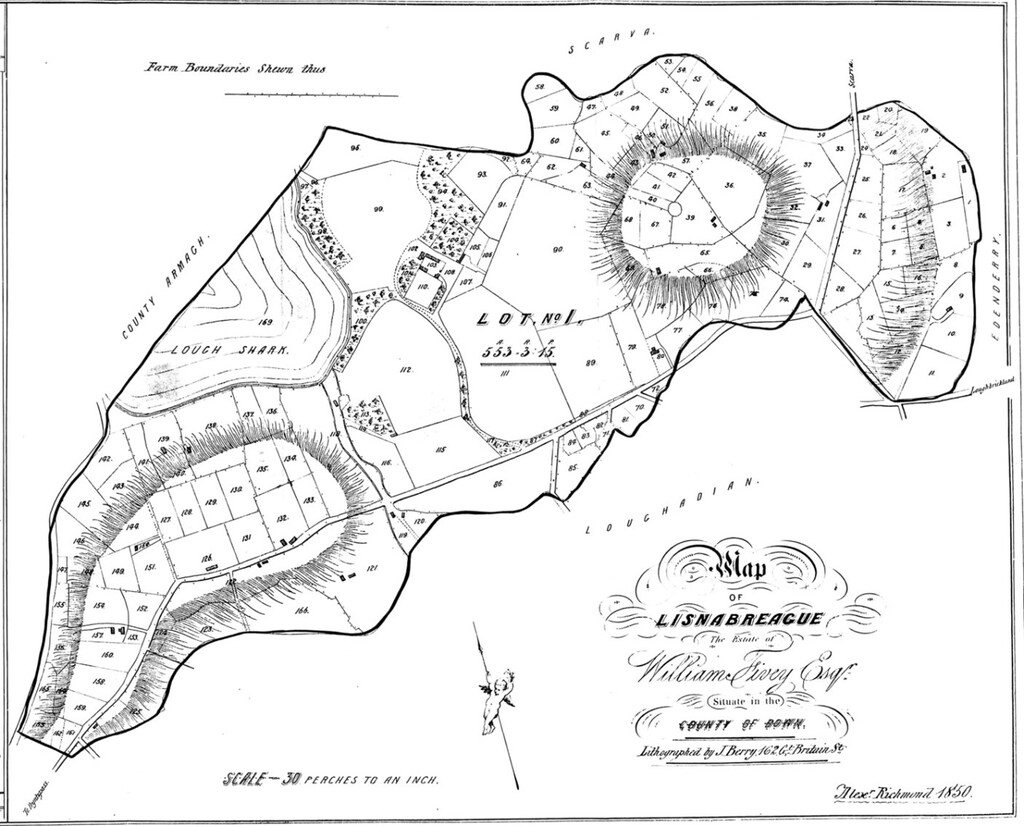
In 1850, he produced the maps in the documents pertaining to the sale of William Fivey’s estate (Lisnabrague and Edenderry) by The Commissioners For The Sale of Encumbered Estates.
In the latter months of this sale process, the name of David Richmond, his oldest son, also appeared in the ‘for sale’ adverts. “CE” (Civil Engineer) is appended to both names in 1853. Alexander’s name also appears as the surveyor in adverts in 1858 for the procurement of “several thousand tons of stones” for the repair of the road from Newry to Charlemont.
In October 1858, he acted as agent for the sale of Dr. Sanderson’s house.
Like most of his middle-class contemporaries, he was also a farmer. His name appears on the 1828-35 Tithe Applotment Books as holding land in Brannock and Federanagh.
PRONI holds a large number of maps produced by Alexander Richmond among its many collections of papers pertaining to the large estates of the time, from all across the north of Ireland; the first map they hold is dated 1822, and the last is dated 1861 when he would have been aged 78.
In April 1860, the Newry Telegraph recorded that he had subscribed £5 to The Newry Auxiliary For Promoting Christianity Among The Jews!
Alexander was a well-off man by the standards of the time when he died on 3rd November 1867, aged 80. His probate valuation was “under £4,000” – i.e. somewhere between £3,000-4,000.
David Richmond (1826-1903)
David was Alexander’s eldest son. He served as his father’s assistant for three years and then obtained a BA from Trinity College, Dublin. He was in private practice from 1849 to 1855, specialising in water infrastructure. In the early 1850s, his name started to appear alongside (and then instead of) that of his father in newspaper ‘estate for sale’ adverts. A March 1853 advert specifically mentions David as being the Receiver for the sale of William Fivey’s Loughadian estate.
On July 4th, 1854, David and his brother William appeared at Poyntzpass Petty Sessions, charged in connection with the riotous Orange march that had taken place late in the evening of 23rd June (The Poyntzpass Riots) but the charges were dismissed.
In 1855, aged 29, David travelled to India where he became an Assistant Engineer for the newly-formed Bombay, Baroda and Central Indian Railway. Bombay is now Mumbai and Baroda is now Vadodara. They are about 240 miles apart, so it was a major project. The company had just been founded that same year, so David’s job presumably involved the initial planning and construction (completed in 1864). He was elected as a member of the Institute of Civil Engineers in 1868. In 1873, by then the railway’s Deputy Chief Engineer, he retired, at the young age of 47, and returned to Co. Down.
He died in Warrenpoint in 1903.